
Squirting happens when arousal is high, the area around the urethra is swollen and sensitive, and the person receiving feels safe enough to stop holding back. Your job as a partner is to make all three true at once.
1. Talk first, and take the pressure off
Never make squirting a goal she has to reach. Say the opposite: "I'd love to try something, and if nothing happens it's still a great night." Agree on simple words like more, stay, softer and stop. And promise that whatever happens, you'll love it. You will.
2. Prepare the room
Put two large dark towels (or a waterproof blanket) on the bed, have water-based lube within reach, cut and file your nails short and smooth, and give it at least 30 unhurried minutes. Suggest she pees beforehand: it removes the "what if it's just pee" worry.
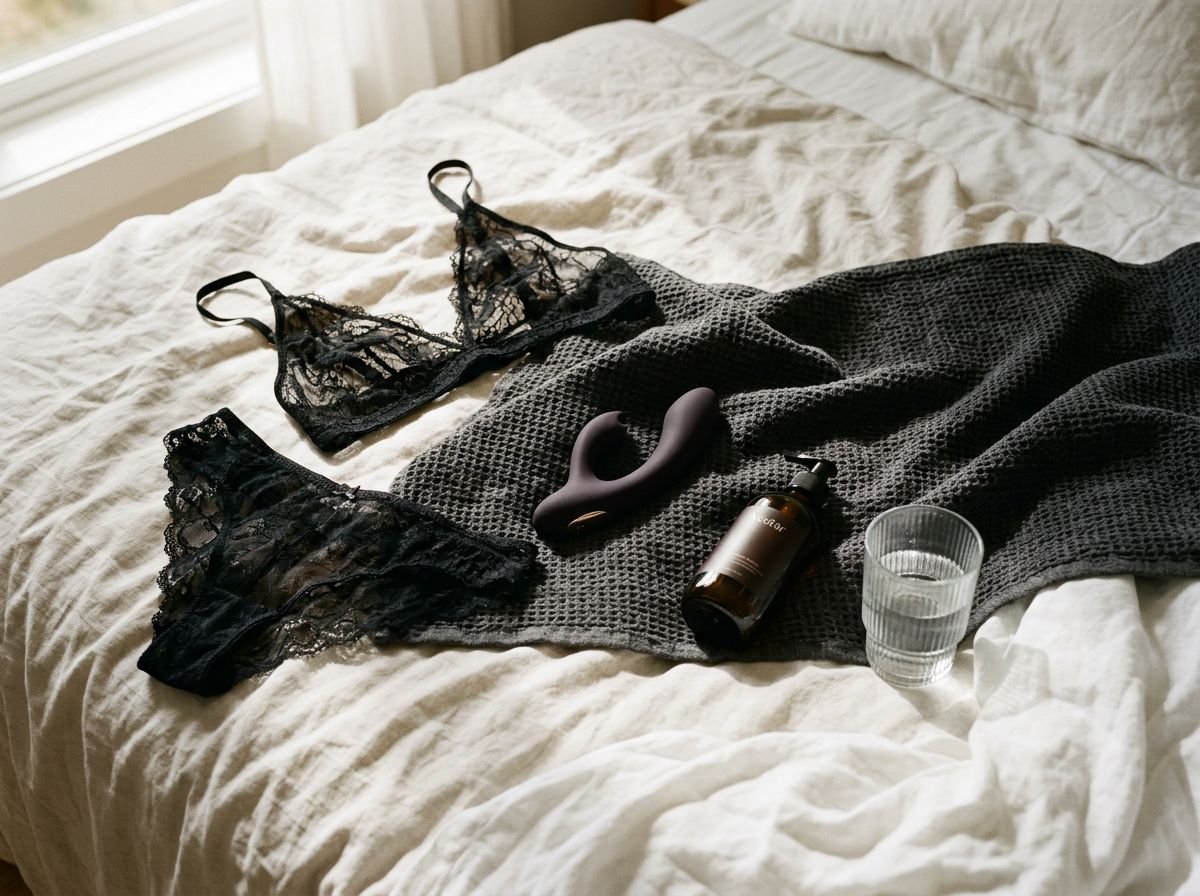
3. Build arousal slowly
The G-spot area only becomes sensitive once it's swollen with arousal. Spend at least ten minutes on kissing and touching without going inside, then focus on her clitoris until she's close to orgasm, or has one. Many people find the second orgasm is the wetter one.
4. Find the spot
- Slide in two fingers, palm facing up, with plenty of lube.
- Go in about two knuckles (4–6 cm) and curl your fingertips toward her belly button.
- Feel for a slightly ridged, spongy patch on the front wall. It gets more pronounced as she gets more aroused.
- Ask: "Here? Firmer? Deeper?" Her feedback beats any diagram.
5. Use the come-hither motion
Make a steady "come here" beckoning motion with your fingertips, about once per second, pressing up into the front wall. Move from your arm and shoulder, not your wrist, so you can keep going. Gradually go firmer, not faster. Adding a wand or your other hand on her clitoris is the combination most women report helps.
6. The moment of release
Encourage her to breathe out slowly and gently bear down, as if starting to pee. Many people find the release happens the moment you slide your fingers out at the peak while pressing just above the pubic bone with your other hand. It may be a trickle, a gush or several waves: keep stimulating lightly.
7. Your reaction is everything
In a large Swedish survey, 86% of partners reacted positively, and women whose partners reacted badly were much more likely to start holding back. Smile, tell her how hot it was, and laugh about the towels together. If nothing happened, say exactly the same thing.
Sources: Salama et al., Journal of Sexual Medicine (2015); Inoue et al. (2022); Pastor & Chmel, Clinical Anatomy (2022); Hensel et al. (2024); Påfs et al., Sexual Medicine (2024).
Frequently asked questions
Can every woman squirt?
Not everyone does, and that's normal. Surveys find roughly 40–60% of women have experienced it at least once.
How long does it take to make a woman squirt?
Plan for 20–40 minutes including a long build-up. Rushing is the most common reason it doesn't happen.
What's the best position to make her squirt?
On her back with a pillow under her hips, or at the edge of the bed, so your fingers can press upward toward the front wall.
Is squirting the same as an orgasm?
Not always. It often happens close to orgasm, but it can also happen without one, and orgasms can happen without squirting.